Fiction Elements Every Writer Needs to Know & Margaret Atwood Writing Advice
June 15, 2026

Today’s Contents:
Raymond Recommends: What to Watch, Read, or Listen to This Week: Three suggestions for a stimulating week of media.
Writer’s Quote: Margaret Atwood on having others read your manuscript.
Fiction Elements Every Writer Needs to Know: These terms aren’t just an academic exercise. Understanding them can help you improve your writing.
5 Resources for Writers: Good stuff for writers.
Raymond Recommends: Watch, Read, or Listen to This
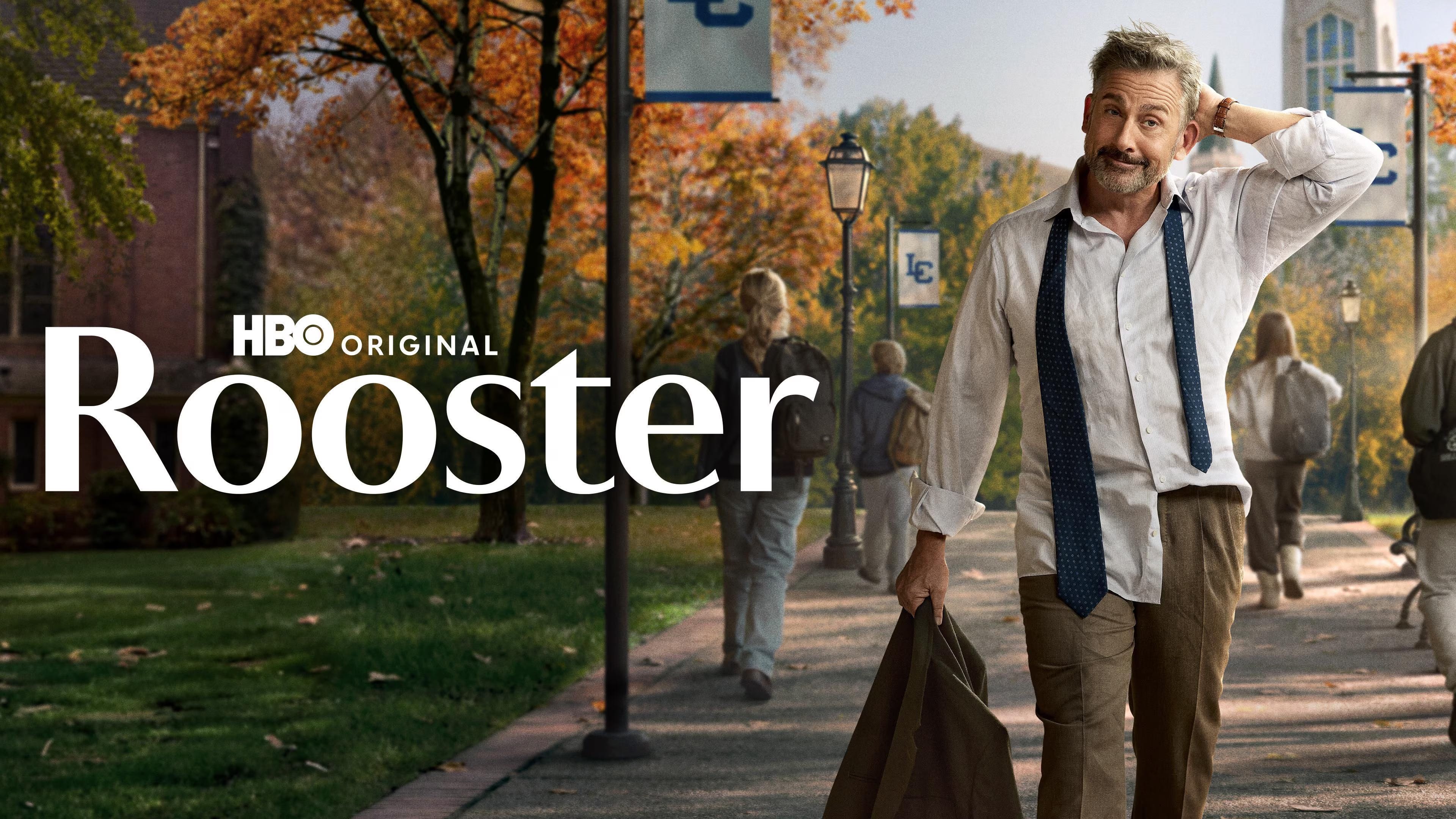
TV: In the campus comedy Rooster (HBO), Steve Carell plays a writer of action novels who is asked to teach a creative writing course at the same university where his daughter teaches art history. As a college creative writing teacher and author, I’m naturally drawn to such premises. Fortunately, this one pays off in both very funny comedy and in heartfelt moments. The characters are all unique creations, each with a distinct voice. The dialogue is sharp and witty. See also Lucky Hank (AMC) with Bob Odenkirk as the creative writing professor who’s given up. Equally funny. But definitely skip Vladimir (Netflix) with Rachel Weisz as the creative writing professor. It’s cliched and lacks the wit and humor of Rooster and Lucky Hank.
Writer’s notes (Spoiler Alert!): While the show is feminist-forward in its themes, part of me cringed that several of the women were portrayed as being wildly irrational when it came to romance. Two of the young women are in love with the same man, a preening narcissist professor who is a liar and a cheater and an overall bastard. They know this, yet they can’t reject him until the end of the season. The show needs them to be hooked to create conflict and humor, but I wish it were more believable. Yes, people are stupid when it comes to love, but the writers must make us believe that these particular people will be this stupid over this man.
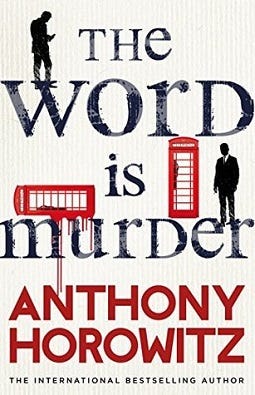
Books: British writer Anthony Horowitz is famous for his Alex Rider novels, which have been made into movies and a popular TV series. He’s also known for his Susan Ryeland mysteries (Magpie Murder) and the TV mystery series Foyle’s War (which I have watched twice). A few years ago, he started an unusual metafiction mystery series featuring himself as a character who plays Watson to a brilliant but abrasive detective Hawthorne. I’m now reading the third in the series. As a writer, I was so intrigued by the idea of inserting myself in a novel as the first-person narrator that I tried it as an experiment. I found it very exciting and liberating. Of course, because it’s a novel, I quickly had to fictionalize myself to some degree. But I highly recommend writers try it as an exercise. The challenge, of course, is to make yourself relatable and likable, yet also vulnerable. Although the novels aren’t as wonderful as the Thursday Murder Club series or as brooding as hard-boiled mysteries, they are very entertaining with lots of references to his life as a writer, including shooting Foyle’s War, meetings with his agent and publishers, and interaction with other writers.
Writer’s Notes (Spoiler Alert!): Horowitz has had to make his own character a bit of a passive wimp in order to contrast Hawthorne’s secretive and manipulative character. But he sometimes goes too far, allowing his fictional character to endure a lot of humiliation and abuse that the reader doesn’t believe a successful writer would permit. Hawthorne deliberately lies to him in order to embarrass him in front of his publishers and bursts into a meeting Horowitz has with Steven Spielberg and Peter Jackson that results in him losing a movie deal. It’s meant to be played for comedy, but the lack of believability that Horowitz wouldn’t tell Hawthorne to knock it off or look for another writer is overwhelming. The Dr. Watson in the BBC Sherlock series is the perfect balance of unwitting foil to Holmes that allows for comedy and mystery, but still a strong and formidable character. The difference is that Watson is motivated out of love for his friend but Horowitz doesn’t even like Hawthorne.
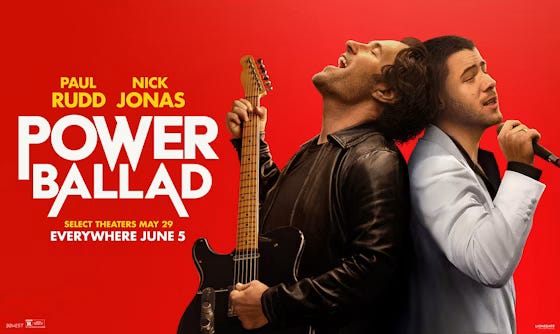
Movies: There wasn’t anything playing that I hadn’t seen or wanted to see, so I went to see Power Ballad. I’m very glad I did. The film is directed and co-written by John Carney (Once, Begin Again), who specializes in modest productions about musicians. Paul Rudd plays a once-famous rock star who is now fronting a wedding band in Dublin because he gave up the rock life when he met his wife and they had a daughter. He’s content in his life, though he has the occasional twinge about what he gave up. One night he meets a famous pop star (Nick Jonas) and they spend the night drinking, smoking, and playing music. Jonas, whose career is in a slump, steals Rudd’s original song and turns it into an international hit. No one believes Rudd wrote the song and it drives him to desperate—and funny—things. Highly entertaining.
Writer’s Notes (Spoiler Alert!): This week alone I’ve seen four Big Argument tropes in movies and TV shows (including Netflix’s new romcom Office Romance. Every one of them sucked. In these stories, the happy couple must have a fight in order for them to split up, thereby creating suspense about how they will come back together again. That’s a necessary element and I’m all for the trope. But a good writer must make it believable so it doesn’t feel like an AI-written cliche. Rudd’s wife kicking him out after a car accident (which is also forced) doesn’t go with the close relationship that the film has established. I can explain why she does it, but the audience doesn’t feel it’s authentic. It’s a false note in an otherwise enjoyable film.
Writer’s Quote
“Ask a reading friend or two to look at your book before you give it to anyone in the publishing business. You can never read your own book with the innocent anticipation that comes with that first delicious page of a new book, because you wrote the thing. You’ve been backstage. You’ve seen how the rabbits were smuggled into the hat. This friend should not be someone with whom you have a romantic relationship, unless you want to break up.”
—Margaret Atwood, Canadian author of The Handmaid’s Tale
This is excellent advice. Following it can save you many embarrassing rejections and, more important, vastly improve your novel. Many famous writers share their work with other writer friends before sending it to their agent or publisher and the notes they get back aren’t always lavish praise, but rather practical suggestions for making the book better. C.S. Lewis and J.R.R. Tolkien exchanged manuscripts. So did T.S. Eliot and Ezra Pound. Stephen King has readers. (For other contemporary authors who share their works with friends and groups read “Conversations With Friends (Who Are Also Writers).”]
I get why Atwood warns against having someone you’re romantically involved with. They can be too gentle, too kind, more concerned with their lover’s fragile ego then improving the book. However, many writers rely on their romantic partner for honest, even harsh, criticism. My wife Loretta, an accomplished poet, is my editor and she is brutally honest to the point where I sometimes feel a seething rising up as she explains what needs to improved. At the same time, I know she’s almost always right, which makes me grateful. The worst part is when she zeroes in on something that I suspected needed work but which I hoped no one would notice. In the end, she always improves my work.
If you don’t have a close friend who is knowledgeable about writing, then it’s best to join writing groups or take a writing workshop class at your local community college. Remember that not all members of a writing group are equal. You’ll have to learn whose advice to listen to and whose advice to ignore.
The goal is to write the best work possible, using all available resources. If you write just to receive praise, get out of the business.
Important Writing Tip: I tell my students this tip every semester because it is one of the most important lessons I will ever teach them. Read your works aloud, preferably to someone else. Many professional writers have offered this same advice. The reason reading pages aloud is so effective is that you can actually hear bad writing better than you can see it. You hear sentences that don’t make sense. You hear repetition. Many times I’ve polished pages until I think they’re near perfect. Then I read them aloud and I hear all the flaws.
Reading to someone else is especially helpful, not because you want their feedback, but because when you know there is an audience, you’re especially mindful of what works and doesn’t work. They are more a prop than an editor. But it works.
Fiction Elements Every Writer Needs to Know (and How to Apply Them)
There are a lot of elements in a novel and it’s not easy to keep track of each one as you’re writing. Here’s a handy, deliberately brief guide to all the elements in fiction. This will make it easier to take a closer look at what you need to work on in your writing.
Plot
Plot, strictly speaking, is what happens in the novel. The events that take place. This has nothing to do with theme or meaning, only activity. For example, the plot synopsis of The Catcher in the Rye: adolescent boy is thrown out of prep school, makes his way back home to New York, confronts various people. That’s it. It’s the same plot as Homer’s The Odyssey.
If a plot is good, it should surprise you, not with arbitrary twists and reversals, but with the variety of possibilities of human emotion. If the novel is a well-travelled genre formula, the reader expects, even wants, certain conventions. That’s part of the fun. However, they also expect some fresh twists. The challenge is to make these plot twists the result of the characters and their needs and desires.
Plot twists for their own sake, without proper motivational groundwork, results in a series of events that seem unrelated. For example, you’re writing a Western, you have a gunfight at the end, and you decide it would be a neat twist if the good guy loses. That may be unexpected, but is it justified? Why did the bad guy win? What does that say about all the things that happened before? Was the good guy morally weak and therefore did not deserve to win? Maybe the reason the good guy is fighting is to prove himself rather than save the town; this would make his motivation pride and a tragic ending would be appropriate (such as Hemingway’s Old Man and the Sea).
Arbitrary plot twists can reduce characters to mere mannequins.
Setting
Setting is merely the location where your action takes place. Properly describing these settings in your novel makes the difference between the reader fully visualizing the scenes or not.
Sometimes setting influences the whole flavor of a novel, suggests theme and texture as well as visuals. For example, Gone with the Wind, The Sound and the Fury, and Grapes of Wrath depend on their setting to fully reveal theme. They are about the place and the influence of that place on the characters and the decisions they make.
Also, setting can just make the events more interesting because it’s more dynamic to read about. A tender scene between a flirting couple can sometimes be more fascinating if it takes place with a football game behind them, or while they’re walking along an assembly line of ramen noodles she’s inspecting. And so on. This doesn’t mean all settings must be exotic, just that you need to look more closely at each scene and decide what setting best compliments the emotional content.
Characterization
This is what distinguishes one novel from another. Even if the plot is a little tired and predictable, we can love a novel simply because the character or characters are fascinating or unique. Novels with excellent characterization: The Maltese Falcon, Getting Straight, Moby Dick, The Stand, Rumble Fish, etc. Read these novels and highlight the scenes, dialogue, descriptions that focus on developing character. These aren’t the only ones, not even the best, but they offer different styles of characterization.
The mistake many writers make is to define their protagonist only by a specific trauma from their past. That keeps the character from being fully developed and makes them less interesting. What interests do they have other than thinking about their trauma? Show them actually doing something that doesn’t involve the trauma, something they have a passion for. (For more on this read our article “Why Trauma Alone Does Not Make an Interesting Protagonist.)
One way to help you develop characters more fully is to use a character description form. By filling one out for each main character, you are forced to ask and questions about your character that will give you a richer perspective on them. (Use the one provided or create your own.) It’s not important that you fill out each line item (though it wouldn’t hurt), just that this form makes you think about your character beyond their defining trauma.
Writing Tip: The following form isn’t just for understanding your characters better. It’s also a reference guide that you can refer to as you write so you can maintain consistency in your character information. I keep a notebook of these forms for all the main characters. When I’m writing later in the novel and need to remember what make car one of the characters owns, I just look at the sheet. Saves a lot of time.
Character Development Worksheet
Character Name:
PHYSICAL
age:
eyes:
height:
hair:
weight:
build:
voice:
scars, marks, tattoos (causes):
health:
clothing:
habits/mannerisms:
BACKGROUND
occupation:
home:
birthplace:
parents:
spouse/lover (current/former):
children:
military:
education:
car:
pets:
sports:
peeves:
hobbies:
magazines/books:
favorite movies:
favorite music:
favorite food:
CHARACTER ARC
Goals:
What does the character want in the course of the novel?
What does the character want over the course of their life?
What are the obstacles in their way, both internal and external?
Attitude:
What is the character’s attitude about themselves and others? Sarcastic, hopeful, compassionate, etc.
Motives:
Why does the character want what they want?
Why do they have whatever attitude they have?
Conflicts:
What are the internal conflicts they face (self-doubt, fear of intimacy, etc.)?
What are the external conflicts they face (bad romantic relationship, bad job, etc.)
Character Motivation
Why do people do what they do? This is the burning question that we ask ourselves daily about those around us, about ourselves. And this is the bedrock of literature. Curiosity about what people do is gossip, melodrama. Curiosity about why they do it is drama.
Where writers often fail in providing motivation is by taking some cheap, easy way out. Nothing makes a novel fall apart faster than lame psychological motivation provided by a bad writer. Their relationship with their mother/father made him do it. Something traumatic in their childhood made him do it. While those are legitimate motivations, they need to be well developed to be persuasive. When done well, you have sensitive powerful stories. When done poorly, you have trite, melodramatic drivel.
For help in developing believable motivation read our previous article “How to Psychologically Analyze Your Characters’ Personality”
Beginning
The opening scene of your novel or script may be all that ever gets read. If it doesn’t have the passion, style, pace, depth, energy that you want the reader to feel, then rewrite it until it does. If the opening is flat, the reader will toss it aside and pick up the next work. This is especially true if it’s a busy editor or agent doing the reading.
On an artistic level, the beginning sets the mood. You are manipulating your audience into reacting in a way that will A) make them want to keep reading and B) make them care about what they are reading.
Writing the first 50 pages of a novel can take as long as writing the next 200 pages. This is because so much polishing and rewriting is necessary to achieve the correct balance that will be maintained throughout.
Accessibility
How easy is it for the reader to understand your novel? It is not necessary that they understand every thematic sublayer upon first viewing; this rarely occurs even in the best of books and movies. Multiple readings and viewings and much thought go into fully understanding them. However, they ought to be able to follow the action, what’s going on and why. If they can’t, the novel is inaccessible.
This term is relative to your target audience. If you are writing a novel for a select group, a sort of cult following (i.e., Ulysses, Journal of Albian Moonlight) you don’t care that a certain level of reader may not “get it.” That’s fine. That just means your novel may be a hard sell to publishers, yet still be a work of genius.
But even if you’re trying to write something very literary, the reader must be able to follow the story to care about what happens. If the technique is too flashy, too high-concept, high-tech, flash-in-your-eyes, the reader can’t get involved. It’s as if you’ve spent $200,000 to decorate your house, but when you invite friends over to view it, you make them see it through dirty windows.
Style
Each writer has his or her own style completely apart from the events and dialogue within the novel. Compare Philip Roth, Raymond Carver, Anne Beattie, Bobbie Ann Mason, Don Delillo, Gillian Flynn. Their styles are so amazingly different, yet each effective in its own way.
The best way to truly understand the unique rhythms of each writer’s style is to type up a couple pages from each writer. The best way to develop your own unique style that is distinguishable from everyone else is to let your voice come through. Be bold, be daring. Write what you’re thinking. But then go back and edit and polish. Hone the blade to a sharp edge.
Tone
Each novel has a dominant tone: pathos, comedy, suspense. Your novel needs to know how to keep your dominant tone consistent, yet use other tones as counterpoints to make your dominant tone more powerful. For example, the humor in Terms of Endearment makes the death scene all the more poignant.
Pacing
There is no right pace in a novel, nor even should the novel be the same pace throughout. A novel that is non-stop action can be just as dull as a novel in which nothing happens. Pacing is directly related to what effect you want to have on your reader. A slow-paced scene preceding a fast-paced scene makes the fast scene seem even faster. Conversely, if you want to make a tender scene have more impact, sometimes placing it immediately after a hair-raising action scene gives the tender scene more impact.
The golden rule of pacing is that it keeps the reader reading. Think of pacing like a current in a river with the reader sitting on an inflatable tube. The current may speed up and slow down at times but the reader enjoys both those sensations. It’s when the water stops moving that they get bored and jump off the tube and out of your novel.
Structure
This is the blueprint of your plot. It’s not enough to have a million wonderful plot events, the effect of those events depends on the order in which they occur: The Structure. Everyone talks about the typical three-act structure. 1st Act: introduce conflict (character wants something; put something in his way). 2nd Act: complicate conflict (character gets what he wants, but finds it’s not really what he wants, etc.). 3rd Act: character devises plan to get what he wants despite difficulty.
Obviously this is a rough sketch of structure, but fairly accurate. The principles are sound, though there’s no need to stick to the letter of this “law.” However, if you ever go to a pitch meeting to discuss the script or novel, be prepared to talk about it in the three-act terminology.
For a much more detailed description of the three-act structure, read our article “How to Use the Three-Act Structure.”
Dialogue
Remember that not every character in your script should speak the same, with the same cadence, the same structure. Make them individual in their choice of words, their rhythm. An excellent exercise: record a conversation between people without them knowing it. Then type the conversation. The act of typing it, more than just reading it, will teach you how the words go together.
Dialogue is not just about delivering information. Nor is dialogue good just because that’s how people talk in real life. Dialogue in fiction should be realistic, but it also must be entertaining. That means characters speak with more wit, humor, precision, cleverness, etc.
Writers well known for excellent dialogue include screenwriters David Mamet, Aaron Sorkin, Quentin Tarantino, Nora Ephron, and the Coen Brothers. (See also “15 Movies Screenwriters Should Watch to Study Dialogue.”) Fiction writers include Lorrie Moore, Elmore Leonard, Richard Osman, George V. Higgins, Elizabeth Tallent, Raymond Chandler, etc.
Conflict
Every scene in a novel or script must have conflict. Without conflict, there is no story. Conflict can be overt (i.e., an alien trying to devour a ship’s crew) or subtle (i.e., a boy trying to grow up outside his father’s considerable shadow). There are two types of conflict: The story’s core conflict, around which the entire story is structured, and minor conflicts that compound the major conflict (i.e., a boy gets in fights at school, even though the main conflict is his fear of his parents divorcing).
Too often beginning writers create scenes that exist merely to deliver information or to transport characters from one scene to another. Those scenes do not need to exist. Information can be included in a more dynamic scene. People can just arrive at their destinations without details of how they got there. I just read a novel that included a scene of the main characters taking a small plane to an island destination. The ride was mildly scary. But that wasn’t enough to justify the scene. The scene could have started with the characters stepping off the plane or even arriving at their hotel.
Especially important is the misdirectional conflict. This is a widely used device to give scenes more tension and interest, even though they aren’t related to the core conflict. For example, you have a talking heads scene in which a husband and wife are driving to a party. The point of the scene is for them to discuss the upcoming visit of a particularly sour parent. Yes, there’s conflict in that discussion, but it can be monochromatic and therefore repetitious, making the scene flat. A misdirectional conflict might be that one of them doesn’t want to attend the party because someone will be there they don’t like. Or one of them is feeling a bit sick and wonders if she might be pregnant. Or they get a flat tire and have to deal with that. This isn’t just a throwaway device, but allows for us to see how the characters will cope in such situations.
Ending
The best endings seem inevitable without being predictable. It’s satisfying, not because it’s happy (though it may be), but because it feels like the best possible ending. At the same time, it shouldn’t be predictable. At the end of the romantic comedy the lovers will get together. Although that’s predictable, what doesn’t have to be predictable is how the writer brings them back together. Then the ending must satisfy by delivering the expected ending in an unexpected way.
The ending is the final piece to the puzzle, enabling us to look back on everything that’s happened before with new vision. Everything that’s happened is clearer now, more significant.
The final scenes suggest the characters’ future. We have a feeling how they will fare from now on.
Bad writers just tack on an ending for emotional impact, without any consideration for character. They want the hero to die because they think it’s edgy, not because they have a great thematic reason.
For more on scene and chapter endings, read our article “How to End a Scene or Chapter with Maximum Effect.”
Mechanics
If your novel does not look professional, no one will take it seriously. Mechanical errors (spelling, punctuation, grammar, etc.) are one of the main reasons manuscripts are rejected by editors and agents. Remember, they get dozens of submissions every day. Don’t give them an easy excuse to dump yours before they even read it.
Originality
This element is a factor in all of the above categories. It doesn’t necessarily mean doing something completely different from what’s ever been done before. It means making your novel an individual expression of your vision, even if it’s a variation of an old formula. Falling in love always feels the same, yet it is never the same experience twice. Same with art. We want to see the world through your eyes, but what you see must excite and entertain us. We want your passion, not just a photocopy of someone else’s work.
Theme
There’s a lot of confusion about themes. Many people think it’s a one-to-three word distillation of the story: Family Betrayal, A Mother’s Love, Humans Versus Nature, Society’s Hypocrisy, and do forth. Those are categories, not themes. They don’t tell us anything. A theme is a statement about what insight your work if offering the audience.
Theme isn’t about the details of the plot but a synopsis of what the plot adds up to. Here’s the theme to The Catcher in the Rye: After the death of his younger brother, a teenage boy struggles with accepting that life is unjust, despite society’s insistence through art and religion that it is fair. This impossible struggle to protect children from this horrible truth drives him to a nervous breakdown and eventual acceptance.
It’s fine if you’re writing a genre novel or script and don’t know what the theme is. But all stories have a theme, whether the writer is aware of it or not. Knowing the theme allows the writer to better craft the story so there’s a cohesion to the plot nd characterization. Writers who don’t bother understanding theme are just imitating other stories they’ve read or seen. There’s a bland predictability to their stories, even if they are viscerally entertaining. It Follows (2014) is a horror film, but it also has a theme about the how fear can turn humans into worse monsters than the ones they’re afraid of. The Westerns 3:10 to Yuma (1957) and The Wild Bunch (1969) follow the usual Western tropes, but are also great literary works with rich themes. The Coen Brothers’ Raising Arizona is a zany crime-comedy but with a specific theme that ties it all together.
In the coming weeks, we’ll be presenting more details about how to think about theme as well as how to use theme to structure your plot and develop characters.
5 Resources for Writers
We did our part. Please do yours and subscribe.