
Earth Angel: Chapter 3
May 22, 2026

chapter three
Mom was annoyed. “How much longer?”
“Soon,” I assured her. She had flown across the country to support me in my time of tragedy. She was, predictably, making things worse.
She checked her watch, a Little Mermaid watch we’d picked up at Disneyland yesterday. The one with the bloated bitch-queen octopus on it, two of her fat jewel-braceleted tentacles keeping time. My mother said the octopus reminded her of herself and gleefully snapped it up. I knew she couldn’t wait to show it to her customers back home, have them laugh and shake their heads and say what a nut she was.
“I thought we were VIPs,” she said, pointing to her plastic VIP badge.
“Be patient.”
“Either we’re VIPs or we’re not. It’s that simple. Everybody can’t be a VIP. If everybody here’s a VIP, who are the regular people?”
“Regular people are at work, not wearing cheesy VIP badges on their boobs.”
She made a face. “Okay, I’ll shut up. I’m sorry. I’m nervous, that’s all. I talk when I’m nervous. You know me.” She sniffed her blouse. “This smells funny. Does this smell like urine to you?”
I put my arm around her shoulder. “Relax, we’ll see Roseanne, don’t worry.”
She stepped away from me, that famous insulted look stiffening her face. “You think that’s why I’m nervous? A goddamn television show? Do I look like I give a shit? Do I look like some celebrity hound? Screw Roseanne.”
“Sorry, Mom, I didn’t mean anything. I’m sorry, okay?”
She was crying now. No tears, just dry raspy gasps, not unlike Shaft’s. The other people milling around the fenced-in courtyard where we’d all been herded to await the live taping of the popular sitcom Roseanne, either looked toward us or quickly shuffled away from us. It was like a prison movie and all the other inmates knew a rival gang was about to slip sharpened spoons between our ribs.
I always felt a little like a replacement model for something that broke, therefore it was my special responsibility to stay healthy and keep safe, for my parents’ sake.
“Mom,” I said softly putting my arm around her again. “It’s okay. I’m sorry.”
She pushed me away and began speaking in German. “I’m the sorry one. I come out here to comfort and support you, I end up acting like a brat. You should just shoot me and put me out of your misery.” Realizing what she’d just said, a horrified expression gripped her face and she clamped her hand over her mouth. We just stared at each other for a long moment and then we both laughed, though there was no humor in either of our laughs. She slipped her arm through mine and pulled me close, speaking softly in German. “What will we do with you now, my treasure. What will we do?”
It was a rhetorical question, but she’d already asked me several variations of it since arriving two days ago, which was two days after the death of Shaft. She’d wanted to come out earlier, but I’d told her not to. My mom was 5’1”, 62 years old, a German war bride who’d married my father, an American Jewish soldier, after he’d already slept with her two older sisters. She was seventeen at the time, he was thirty-one. He’d brought her to America, first New York City, than a small town in Pennsylvania where they’d opened a Jewish delicatessen and had a son. They both worked hard from five in the morning until eight in the evening, Dad in the back baking bagels and bread and strudel, Mom out front waiting on the customers, joking and flirting with them in a harmless way.
Their little boy, Karl, helped out, sweeping or washing dishes or delivering sandwiches to the office building across the street. Karl spoke German and English and played basketball on the synagogue’s team in the church league. He led the league in rebounds and was third in scoring. Then one Saturday twelve-year-old Karl didn’t wait for the light to cross the street because he wanted to get off work early to go see a matinee of Mysterious Island. A car pulled out of an alley and killed him. Three years later my parents had me. My mom was thirty-two, my dad was forty-six. I always felt a little like a replacement model for something that broke, therefore it was my special responsibility to stay healthy and keep safe, for my parents’ sake.
While my Mom dragged me to Disneyland and Roseanne in an effort to cheer me up, my dad was back home in Pennsylvania baking. He was 5’ tall, 76 years old. During World War II he hadn’t bothered to get the deferment because he thought he was too short for the army. When they took him anyway, he’d actually wet his pants right there. They pressured him into being a belly-gunner, the riskiest job in the service, because he was so small and would fit snugly in those little bubbles under the planes. On the day he was to be shipped out to join his flight crew, a colonel asked if anyone spoke German and he raised his hand. Actually, he spoke only a little Yiddish, which he’d picked up from his Polish father, but it was close enough to fool the colonel and they reassigned him to army intelligence to translate captured German mail.
Now Dad rose every morning at three o’clock and drove into town to begin the baking for the day. Then Mom would drive into town and open the store for the customers. By then the first batch of donuts and sweet rolls would be done and her regulars would pour in for breakfast and a chat. Mom would make them laugh and they’d be on their way, full and happy. Mom was definitely the star attraction there, the one-woman show that had been running for forty years.
I shrugged. What did I know about real?
I hadn’t wanted Mom to come out here because I knew my father wouldn’t come with her. A few years ago he’d had a triple bypass and since then he’d been terrified of flying. Two years ago they’d gotten on a plane to visit me for a vacation and he’d gotten right off again. They’d taken a train instead. This year his health had not been good and he wasn’t up to even a train ride. He depended on my mother, not so much physically—he was still a strong man hard at work every day—but emotionally. Without her around he would probably end up doing the same thing every night: wander the local mall, eat Chinese food, and go to the cineplex to watch movies he’d already seen. For Mom to come see me would cause more family pain than healing. At least that’s what I’d told her.
But here she was. And here we were, waiting to see Roseanne. Francine had gotten me the tickets. Her husband was an entertainment attorney who represented the comedian doing the warm-up of the audience. Once Francine heard about Shaft, she called to apologize. “My God, I had no idea, Season. I swear. He looked healthy in the store. He was beating the crap out of the other kittens. I feel awful. Look, I want to make it up to you. You like Roseanne?”
“There,” Mom pointed. A woman with a clipboard was talking to people, checking her list. “She’ll know.” Before I could stop her, Mom scooted over to the woman and flashed her VIP badge like she was the sheriff of Tombstone. The woman checked her list, smiled, waved her through. Mom turned toward me with a big grin and gestured for me to follow.
Inside the building we were ushered to our seats. We sat on long bleachers. Many of the seats had masking tape stuck to the backrests with names on them. Our seats had Francine’s last name. The warm-up comic came over and introduced himself to Mom and me, chatted about Francine. Mom exchanged jokes and wisecracks with him and he seemed genuinely amused. He even kissed her hand. Then, midway through his routine with the studio audience, he introduced my mother to the crowd and he and Mom started in doing the same bit as if they’d been rehearsing for years and planned this. The audience thought it was hysterical. She was pretty funny, I had to admit. At the end, Mom bowed to the audience and they gave her a big hand.
After that, the show itself was a bit anticlimactic. Halfway through the taping Roseanne and John Goodman came out and joked with the audience about how their diets were making them crazy. Then she pretended to fire him and he put her in a headlock and gave her scalp nuggies.
On the drive home Mom said, “They seem like nice people. Very real, don’t you think?”
I shrugged. What did I know about real?
* * * * *
The next day we were watching Jenny Jones. We’d already watched Sally, Geraldo, and Jerry Springer. Jenny had people on who had been bullied as children and were so traumatized that they’d never gotten over it. Today Jenny was giving them the opportunity to confront and tell off those former childhood bullies.
Mom was munching on a huge tin of popcorn one of my patients had recently sent me, I guess as a consolation gift. I’d gotten a lot of gifts since Tim had died and frankly I’d never known that gift-giving was a part of the protocol if someone died. Maybe the idea was to shove as much stuff as quickly as possible into the void the dead person created, like stopping up a hole in a dam. Sometimes I laughed when I thought about people discussing what to buy me. What do you get for someone whose fiancé blew away five people before being gunned down by the police? A kitten? Tickets to Roseanne? Popcorn?
“You like these shows?” Mom asked.
I sensed a trap, so I just shrugged. I didn’t want to admit to liking them, though I did. Sometimes Tim and I would watch them together and try to guess which of the four most typical comments the outraged audience member would say: (a) “What about the children? The children come first.” (b) “Communication is the most important thing.” (c) “You people just have no morals.” or (d) “If he were my man, I’d kick his sorry butt right out the door.”
Mom tipped the can of popcorn toward me, I shook my head. The can was divided into three sections: caramel popcorn, cheddar cheese popcorn, and plain popcorn. Mom was alternating between the cheese and caramel, leaving the plain untouched. It’s what I usually did and it bothered me to see her doing it, too.
“The whole time he was praying over the coffin I kept wondering what he looked like naked?”
“You’re skinny, Season,” she said. “That’s no good. Your dad hates it when I get skinny.”
How would you know? I almost said, but let it pass. I was in a bad mood because Mom had spent all morning pressing me about what I was going to do next with my life. It wasn’t just one direct conversation, either, it was a recurrent question that she would just tack onto the end of other conversations so it became like a ghost that kept popping up and shouting “Boo!” at me.
“That Jenny Jones looks good. Not fat but heavy in the right places.”
“She had breast implants, Mom. They went bad and she spent a fortune trying to recover.”
Mom shrugged, munched a handful of cheese popcorn. “She looks fine now. That’s my point. She went through trauma, she recovered, now she’s getting on with life.” There it was: Boo!
“That was your point? You didn’t even know about her trauma until I just told you.”
“What does that have to do with getting on with life?” She switched into German. “I lived through a war. I spent my childhood in bomb shelters. I was supposed to be an artist, go to the art institute, but that was bombed, too. Instead I sewed in a factory and starved. But I managed to fall in love and marry your father. I started a business, had children. Got on with life.”
“Now that you mention it, Mom, the minister who spoke at Tim’s funeral was kind of cute. The whole time he was praying over the coffin I kept wondering what he looked like naked?”
Mother stuffed some popcorn in her mouth and muttered, “Sure, you’re a doctor. Therefore you already know everything there is to know.”
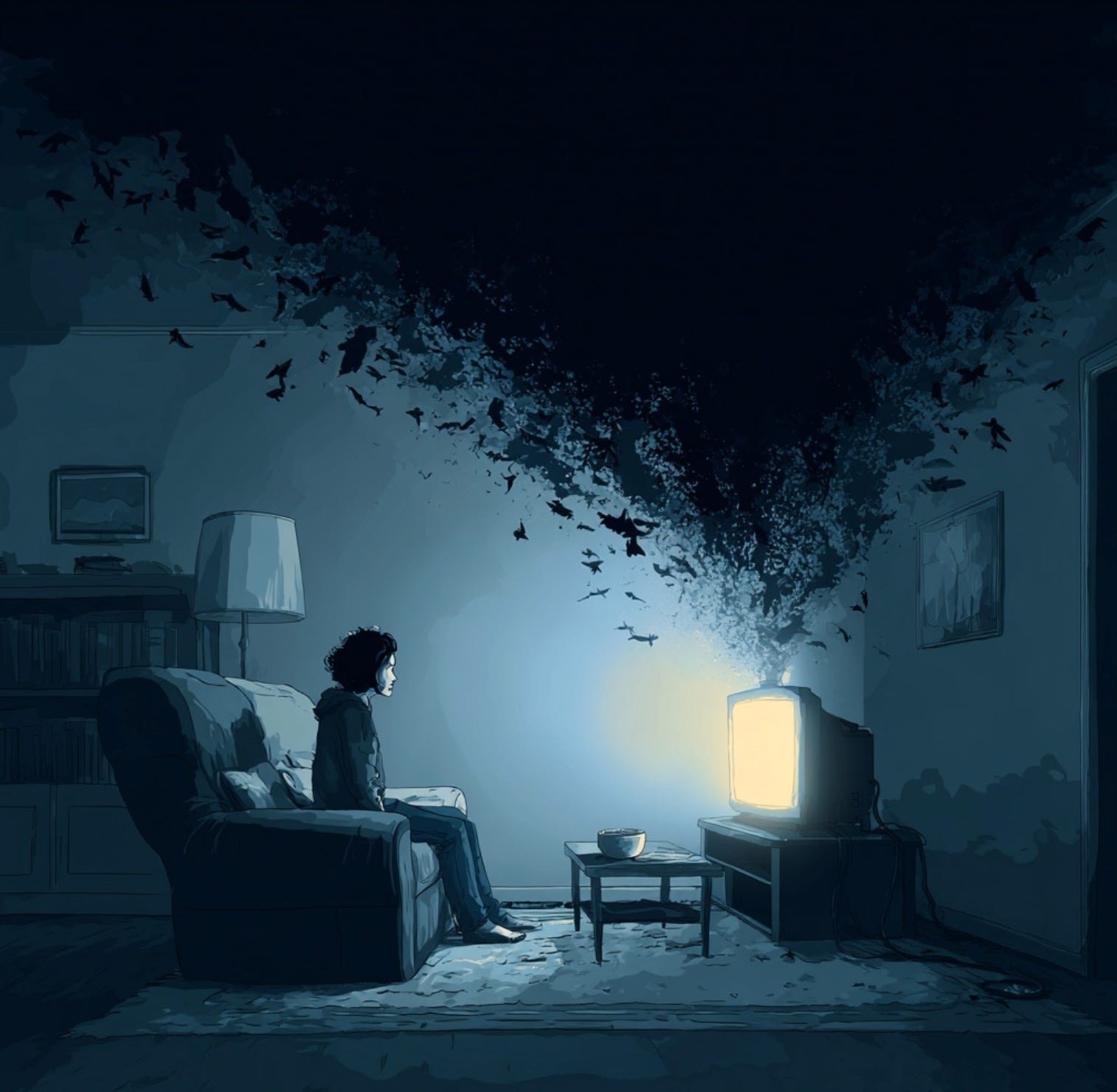
“You know, Mom...” I started, but ran out of interest in what I was going to say. Blah, blah, blah. There was no point to this conversation. Mom was trying to be helpful because she felt helpless and I was being pissy because I felt pissy. We both turned to the TV and let it absorb our mood.
Jenny’s guest, a chubby black woman, was sobbing and hollering at another chubby black woman who, when they were both in junior high school, stole her panties from gym class and gave them to her boyfriend to tape up in the boy’s lav. All the boys stuck their chewing gum to the crotch. At the end of the day the bully dropped them on the crying girl’s desk in study hall, the wads of multicolored chewing gum lining the crotch like those bright neon pebbles in fish bowls. Very festive. The wronged woman was screaming in the bully’s face and the audience was applauding her. The bully was not remorseful: “We were just kids, get over it.” Someone in the audience stood up and pointed at the bully: “You just don’t have any morals.” Someone else jumped up and said, “What about your children? Is this how you want them to be treated?”
The doorbell rang. It was a delivery. A huge assortment of fresh fruit in a hand-carved mahogany bowl so fancy it had a little printed card attached explaining the history of the wood and the mythical significance of the carvings. It was from an ER buddy of Tim’s: condolences, etc. for my loss. I pulled off the yellow cellophane wrapping. “Kiwis. This even has kiwis.” I showed a kiwi to Mom. “You want one?”
She looked at the popcorn, then at the kiwi. She shook her head.
“Look at this. A whole pineapple. What the heck is this thing? Guava? Makes me want to sit down and immediately write a thank you note: Dear Stan, Thanks for the fruit. The guava really took the edge off Tim’s homicidal rampage and death.”
“Your friends are just being supportive. Just letting you know that even though Tim is dead, you’re still among the living. Among them. It’s a token of life.”
I wanted to dump the can of popcorn over Mom’s head, just for the hell of it. Just to see the puffy nuggets of popcorn stick in her gray hair like Christmas tree ornaments. Instead I sat on the sofa next to her, took her hand in mine, even though I had to wrench it from the popcorn bin and her fingers were sticky with caramel and cheese dust. “Mom, it’s like this. I do not know what I want to do next. I know I don’t want to practice medicine right away. Not right away.”
“No one’s talking medicine. Who said anything about medicine. I’m just saying, as a form of therapy if nothing else, you need to keep busy. Do something, anything. Have a purpose.”
“Keeping busy is not the same as having a purpose.”
“If you have a purpose then you’re automatically busy. Common sense.”
“I have no idea what that means.” I sighed. “Mom, look at my life. My baby is dead, my finance is dead, my cat is dead. Doesn’t it have the feel of some supernatural wrath or judgment?”
“What do you mean? Like God?” Mom had converted from Lutheranism to Judaism after marrying my father, but she knew I had never been a believer. “You believe in God now? You think you’re Job?”
“I didn’t say that.”
“You think God’s taking time out of his busy day to ruin your life?”
“Or something. It seems too focused, too directed to be random.”
“What exactly are you being punished for?” Theology required German, as did money discussions or family secrets. “Did you do anything so monumentally evil?”
I shrugged. Perhaps there was something I had done to cause the miscarriage, something unconscious. Everything else that had gone wrong had resulted from that. I hadn’t noticed how bad Tim was, how close to the edge. I lived with the man, for Christ’s sake, I slept with him and I hadn’t known he was capable of this. I was a professional at diagnosing illness and I’d noticed nothing in the person I loved most in the world. What use was I? But I couldn’t say any of this to my mother. She had grown up in a war and lost a twelve-year-old son. She knew about loss and getting on with life.
“Never mind,” I said.
“You ever stop to think maybe it’s me who’s being punished,” she said. “Or your father. Maybe it’s worse punishment to see your child suffer then to suffer yourself?”
I let go of her hands and sat back against the sofa.
“Popcorn?” she asked, tipping the can.
I grabbed a handful of caramel and crammed almost all of it into my mouth. We stared dumbly at Jenny Jones and her outraged guests.
To do nothing is to be nothing, my father always said.
Tim was heavily insured, thanks to his dad being an insurance agent, and a not-too-successful one at that. Tim had bought the policies more to make his dad feel good than because he wanted so much insurance. Whatever the reason, I now had the condo and all our credit cards paid off and about $600,000 in the bank. I could open my pediatrics practice now, the one we’d always planned on. Except I didn’t want to. I didn’t want the responsibility of other women’s children. I didn’t want to diagnosis, treat, and worry over children that weren’t mine and weren’t Tim’s. And I didn’t have any confidence in my abilities as a doctor anymore; I’d let Tim down, I didn’t want to add to the list of fatalities. Besides, for the first time in my life I could afford not to work. To do nothing. To do nothing is to be nothing, my father always said.
Sounded good.
Jenny Jones returned from a commercial to introduce her last guest. Blue waddled in from the kitchen where she’d been eating dry food. She jumped on Mom’s lap and Mom raked her fingers through Blue’s dark gray fur, leaving a yellow cheese dust trail.
“..and extraordinary tale of abuse,” Jenny said. “I know we like to think of small town America as the heartland of morality and good neighbors, a place where people move to so their children can grow up normal. But my next guest says one young girl made her entire childhood such a hell that it was like a concentration camp. From Williamsport, Pennsylvania, please welcome Tanya Zdunn.”
“Williamsport?” Mom said, leaning forward at the mention of our town. “You know this girl, Season?”
Indeed I did. Tanya Zdunn was one grade behind me all through junior and senior high school, part of the group of lumpy students no one noticed unless we were bored. I had never considered myself as part of the in-crowd, but I had my own group of pseudo-intellectual, political-activist, poetry-writing knuckleheads who drank black coffee and white wine and felt superior. Especially to the bunch that Tanya Zdunn hung out with.
“I remember it so...clearly,” Tanya was telling Jenny. Tanya was heavy back then and even heavier now. Her hair was hacked into some sort of style that accented her bad skin. She wore bright red lipstick that framed crooked teeth. “She used to call me the fly, the human fly. Because my last name begins with a Z. Whenever I passed, they’d all go zzzzzzz and pretend to be flies.” Tanya was crying now, mucus bubbled out of one nostril. She couldn’t go on.
My stomach was pureeing a combination of acid and chipped ice. I remembered sitting in the cafeteria seeing Tanya approaching, carrying the tray low to hide her stomach, and I know for a fact that I was the one who said, “Here comes Tanya Zzzzzdunn, the human fly.” And how everybody laughed and made buzzing sounds as she passed by. The look on her face, as if someone had splashed hot soup on her, I never forgot. I might have made fun of her after that, but never to her face, never when there was any chance she would hear. A childhood compromise. But I was the one who’d tagged her with her nickname. I had opened the door to her private childhood hell and booted her in. And now she was about to name me as her bully in front of millions of people. My hands balled into fists which I pressed against my erupting stomach.
“And what was your bully’s name, Tanya?” Jenny asked.
Tanya stopped sniffling long enough to murmur...
I leaned forward, feeling dizzy with guilt.
“...Linda Timmons.”
“Linda Timmons!” I said.
“Linda Timmons?” Mom said. “That the one with the blue Mustang. She always seemed like a bitch.”
Linda Timmons hung with the ultra-popular crowd, the ones who all lived within the same four blocks of each other, went to the same church and summer camps, and never had part-time jobs in their parents’ delicatessen that had a giant Star of David on it—the badge of the Christ-killers. The couple times Mom had met Linda, she’d made a big deal later of how poised and spunky Linda was. I’d taken that as silent criticism at my lack of poise and spunk.
Now Linda walked out on stage, smiling at Jenny, at Tanya, at the audience. She was gorgeous, dressed in a modest dress that nevertheless made her look as if she’d wandered into this room by mistake, could someone direct her please back to the models’ convention. The audience didn’t applaud, angry as they were at the parade of bullies who had spent their fifteen minutes of fame trying to defend their cruel actions. But Linda marched right over to Tanya, hugged her, kissed her cheek, and started right in talking.
“First, let me say this, Tanya.” She took hold of Tanya’s hands and looked her right in the weepy eyes. “What I did to you back then was inexcusable. Yes, we were kids, but that’s just not a good enough excuse. I knew right from wrong, and I knew it was wrong to hurt another person. So, even though I don’t deserve it, I’m asking you now to forgive me and to accept my apology.”
Tanya just stared dumbly, like an animal who’d already gnawed off one leg in a trap sniffing what looked an awful lot like another steel-toothed trap.
“And to prove my sincerity, I’d like you to have dinner with me tonight, at which time I promise to reveal some of the deep dark secrets of my childhood, which you can use as ammunition against me if I ever get out of line again. Including who I lost my virginity to.” She smiled and patted Tanya’s thick, hairy arm.
The audience didn’t wait for Tanya’s response. They burst into lavish applause. Linda hugged Tanya again and the applause grew even louder. Tanya was laughing now, enveloped by the warmth of audience approval and the embrace of her new best friend.
“Well,” Jenny Jones said to the camera, clearly moved. “That was a surprise. We’ll be right back after this break to see what Tanya thinks of all this.”
“That was nice,” Mom said. She tried to push Blue off her lap. “Come on, Blue, let your old grandmother get something to drink. Go to your mommy.” Blue jumped onto my lap and Mom took off for the kitchen. “You want anything?”
“No, thanks.”
I was dumbfounded. I had started this evil nickname but Linda, who undoubtedly had used it to torment Tanya more than I had, not only got the blame, but turned that blame into a positive ceremony of admiration. Maybe that was my crime, starting that whole human fly buzzing thing. I mean, what are the odds that someone I know would be on a talk show when I’m watching, discussing something I did. It had to all be part of the pattern, the overall cosmic message. I ain’t done with you yet, Job!
That night I dreamed of Tim and the shooting. Everything happened just as it had in real life, except that after Tim got shot by the cop and I dropped to my knees to tend his wound, the bullet hole in his back opened like a huge mouth smiling. Inside the mouth were a clump of white maggots wriggling and fussing. They turned into flies and began buzzing around the room. “Locusts,” Tim gasped. “No, Tim,” I said, “they’re just flies.”
And I sprayed a can of Raid into his wound. Then Helen’s dead body came back to life and she lifted herself onto one elbow, the whole front of her uniform shredded from the bullets and stained red from the blood. Only now it wasn’t Helen, it was my mother. “Season, was von die kinder?” she said. “What about the children?”
And I woke up dry-mouthed and smacking my chapped lips. But I was wide awake with the sudden and certain knowledge of what I should do next with my life. Jenny Jones would be so proud.